SCTU-led ISO 18982 Enters FDIS Phase
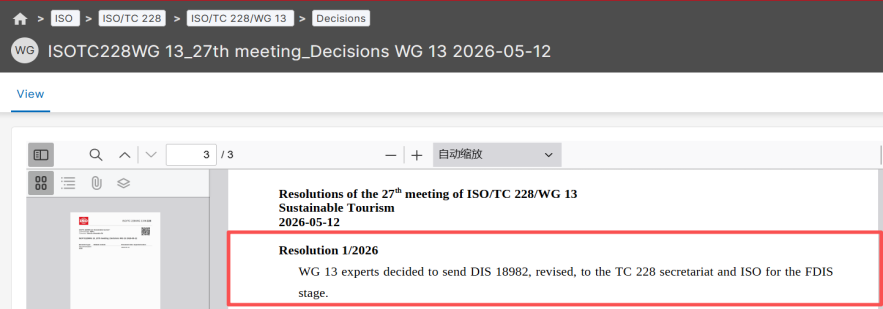
Sichuan Tourism University News Network (Correspondent:Li Xiaolin)On 12 May, the 27th meeting of Working Group 13 (Sustainable Tourism) under ISO/TC 228 – the International Organization for Standardization’s Technical Committee on Tourism and Related Services – took place in Hangzhou, China. The meeting passed Resolution 1/2026, which sees working group experts unanimously agreeing to submit the revised ISO/DIS 18982 standards to both the ISO/TC 228 secretariat and ISO’s central secretariat, formally advancing the document to the Final Draft International Standard (FDIS) stage. As the lead institution behind the standard, Sichuan Tourism University (SCTU) has taken a major step forward in shaping global sustainable tourism governance frameworks.
Nine core principles create shared rules for worldwide destination management
Rooted in the nine foundational principles set out in ISO 23405 *Sustainable Tourism — Principles, Vocabulary and Models*, ISO 18982 deliversa unified, actionable implementation framework applicable to tourism destinations of all sizes across all regions worldwide.
The standard follows a three-layer “What—Why—How” structure to break down each principle, covering core concepts, real-world significance and workable best practice routes. It sets out nine key focus areas:Effective sustainable tourism management, Protection of local community rights, Natural environment and biodiversity conservation, Preservation of cultural heritage and local identity, Socio-economic progress, Consistent quality of tourism goods, processes and service standards, public health, safety and security safeguards, Full legal compliance, Emergency planning and response protocols.
The standard applies to all stakeholders engaged in sustainable tourism development. It frames a tourism destination not as a standalone attraction or single product line, but as an interconnected system made up of natural resources, cultural assets, resident communities, transport links, public amenities, commercial operators, tourist behavior and official governance systems.
Unanimous member state backing and detailed technical revisions to 44 feedback points
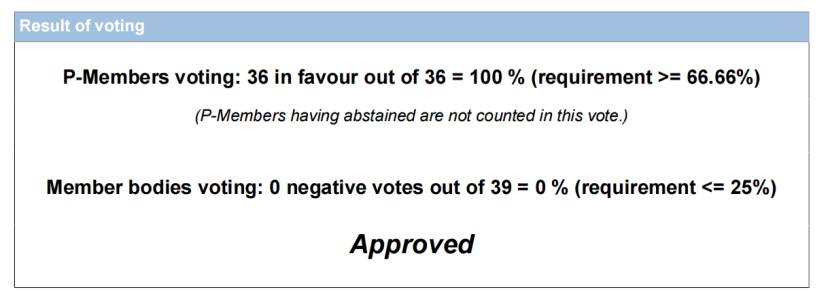
Voting results from the DIS stage reflect broad international backing for the text. Document N2331 from ISO/TC 228 records all 36 participating P-member nations voted in favor, delivering a 100% approval rate – comfortably exceeding ISO’s minimum 66.66% threshold. None of the 39 voting countries cast opposing ballots, keeping rejection at zero, well within ISO’s 25% cap for negative votes.
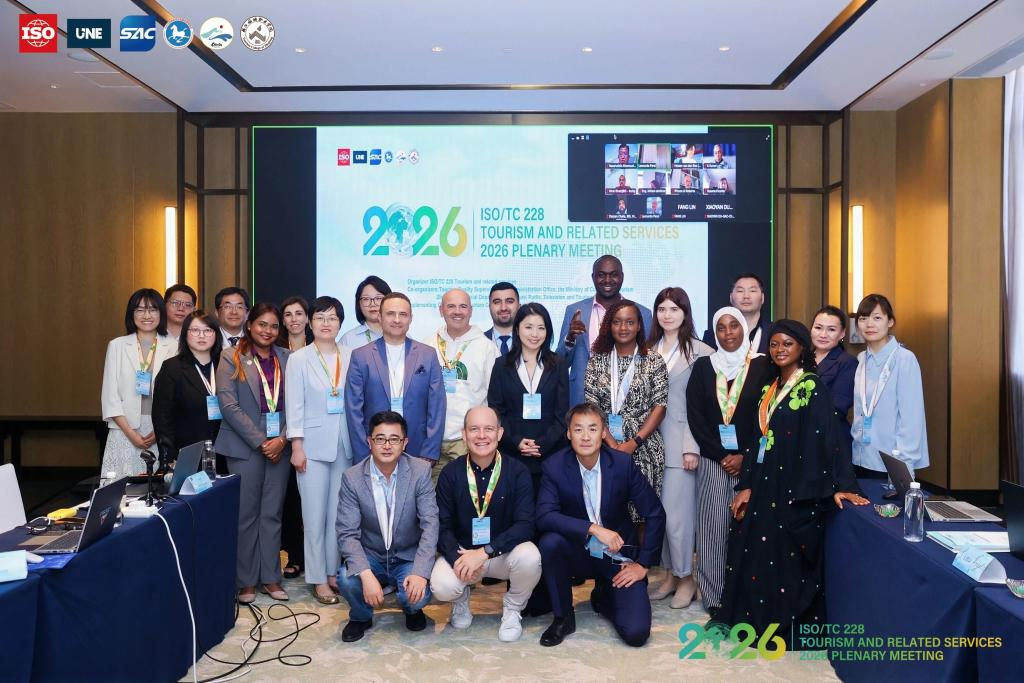
At the Hangzhou gathering, SCTU delegates joined WG 13 specialists from China, Brazil, Spain and other nations to review and resolve 44 formal technical comments line by line. Key adjustments included: Retaining annual monitoring requirements while introducing flexible timelines for strategic planning cycles, to improve practical delivery; Adding clauses requiring stakeholders to map, evaluate and track location-specific climate hazards – such as water scarcity, rising sea levels, extreme weather and ecosystem loss – and build formal climate adaptation plans; Stripping repetitive compliance wording from the main text to align fully with ISO/IEC drafting guidelines. Full technical consensus was reached on every comment raised, greatly boosting the standard’s cross-border applicability and ease of use on the ground.
From academic research to co-developing a global industry standard
ISO 18982 was co-proposed by Sichuan Tourism University and the Commercial Industry Committee of the China Council for the Promotion of International Trade (CCPIT). The joint university-industry cooperation brings together the university’s research strengths and the chamber’s industrial standard development experience. The project stands as a landmark example of regional Chinese practical experience being translated into shared global guidance.
Drawing on long-running institutional research into sustainable tourism, destination governance, heritage protection and tourism emergency management, SCTU has adapted Chinese approaches to ecological progress, rural development, cultural-tourism integration and low-carbon travel into internationally aligned standardized terminology, now adopted widely across the global tourism sector.
Clauses within the standard covering community benefit-sharing, digital cultural heritage archives, smart environmental monitoring platforms, low-carbon visitor experiences and climate resilience capture China’s on-the-ground innovations in ecological compensation, cultural regeneration and digital destination management. They also offer practical solutions to universal challenges facing tourism sites worldwide: over-tourism, climate disruption and limited community involvement in decision-making.
Forward-looking input into international tourism governance
The world economy is undergoing structural shifts, and tourism has evolved from a discretionary leisure activity into a vital engine for livelihoods, consumer spending and cross-border trade. Figures from the World Travel & Tourism Council (WTTC) show the industry contributed a record $11.6 trillion to the global economy in 2025, equivalent to 9.8% of worldwide GDP, with growth of 4.1% – 1.5 times the overall global economic expansion rate of 2.8%. China’s tourism sector grew 9.9% year-on-year in 2025, more than double the global average.
The industry’s strong rebound and structural expansion have raised expectations for better destination governance. Yet alongside growth, sites face mounting ecological strain, community friction, climate risks and gaps in regulatory oversight. The launch of ISO 18982 arrives at a critical moment. It is not merely a park management handbook or promotional green document, but a structured governance framework for tourism destinations, designed to shift global competition away from visitor volume metrics and toward high-quality governance performance.
Sichuan Tourism University will maintain its central role within ISO/TC 228/WG 13, contributing to detailed text refinement during the FDIS phase and supporting global rollout of the standard. The institution will apply its learning to develop the “Magnificent Tianfu · Comfortable Sichuan” regional tourism brand and advance sustainable destination management worldwide.It will also leverage the project to deepen cross-industry and cross-disciplinary collaboration, training tourism professionals with international standardisation expertise. The university will continue to share Chinese practical experience and Sichuan’s tourism insights to support the ongoing evolution of global tourism governance systems.
Previous:SCTU Faculty and Students Volunteer at 2026 Belt and Road Overseas Chinese Conference Next:Professor Zhiyuan, Deputy Minister of Tourism of Sri Lanka, visits SCTU
【Close】